

Dental Implants in Mequon, WI
Get back to being you.
Remember when you could laugh without holding back, order whatever sounded good, or smile for a picture without a second thought?
Missing or failing teeth can change those everyday moments. Dental implants may help restore the comfort, function, and confidence to enjoy them again.
Dental Implants Page
We will get back to you as soon as possible.
Please try again later.
PRECISE, PERSONALIZED IMPLANT CARE
Why choose North Shore Dental for dental implants?
From advanced treatment planning to personalized care, North Shore Dental takes a thoughtful approach to helping patients explore their dental implant options.
Personalized Care From Start to Finish
For appropriate cases, Dr. Craig Smith manages implant treatment from planning and placement through the final restoration, providing continuity of care throughout the process.
Advanced Planning for Predictable Treatment
Every implant case includes 3D CBCT imaging to evaluate your anatomy and help plan treatment. Computer-guided placement is used when appropriate.
Experience and Clinical Judgment
With more than 325 hours of implant-focused continuing education, Dr. Smith combines advanced training with individualized treatment decisions, including specialist referrals when needed.
PRECISE, PERSONALIZED IMPLANT CARE
Not sure if dental implants are right for you?
Whether you're missing one tooth, dealing with a failing tooth, or considering alternatives to removable dentures, the first step is understanding your options.
At North Shore Dental, we'll evaluate your individual situation, explain what treatment may involve, and help you determine an approach that makes sense for your dental health and goals.

Preventive Dental Care
Understanding the dental implant process.
Every dental implant journey is different. At North Shore Dental, we take a personalized approach to planning, placing, and restoring dental implants to support your long-term oral health.
1. Planning and evaluation
Your treatment begins with a comprehensive evaluation. Dr. Craig Smith uses 3D CBCT imaging to assess your jawbone, surrounding structures, and the proposed implant location. This helps guide treatment planning and determine whether procedures such as bone grafting may be needed. Computer-guided implant placement may also be incorporated when appropriate.
2. Implant placement and healing
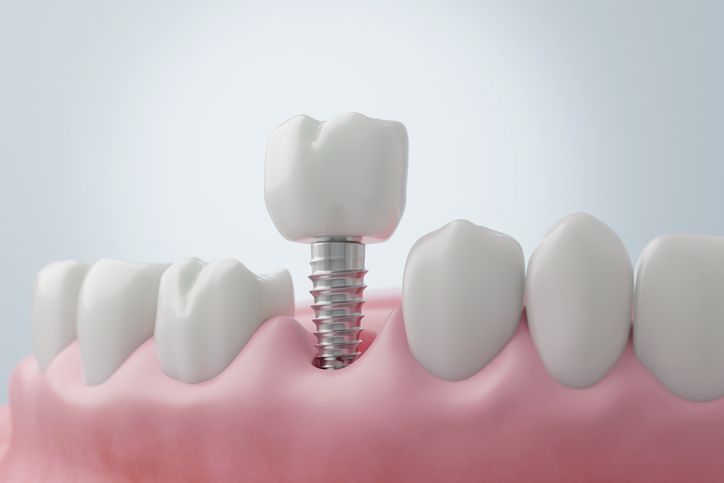
During implant placement, a small titanium post is positioned in the jawbone to support a future replacement tooth. As healing progresses, the implant integrates with the surrounding bone through a process called osseointegration. This phase often takes several months, depending on your individual needs. Additional treatments, such as bone grafting or platelet-rich plasma (PRP), may be considered when appropriate.
3. Final restoration and long-term care
Once the implant has sufficiently integrated with the bone, a custom restoration, such as a crown, bridge, or implant-supported denture, can be attached. The restoration is designed to complement your smile and help restore chewing function. Routine dental visits, good oral hygiene, and ongoing maintenance are important for the long-term success of your implant.
Preventive Dental Care
Recovery and long-term care after dental implants.
Dental implants are designed to provide a long-lasting solution for missing teeth, but proper healing and ongoing care are essential. At North Shore Dental, Dr. Craig Smith guides patients through recovery and provides personalized recommendations to help protect their oral health.
What to expect during recovery
Following dental implant placement, some swelling, tenderness, or mild discomfort is normal. These symptoms generally improve within several days. Over the following months, the implant gradually integrates with the jawbone through a process called osseointegration. Recovery times vary depending on individual healing and whether additional procedures are needed.
How to care for your dental implants
Maintaining healthy gums and surrounding bone is important for the long-term success of dental implants. Brush twice daily, clean around your implants as instructed, and attend regular dental checkups and professional cleanings. Avoid tobacco use and follow your dentist’s guidance for protecting your implants from excessive pressure or grinding.
How long can dental implants last?
With proper care, dental implants can function successfully for many years. However, their longevity depends on factors such as oral hygiene, overall health, and regular maintenance. While the implant itself may remain stable for decades, the attached crown, bridge, or denture may eventually need repair or replacement.

DENTAL IMPLANT QUESTIONS
What to know about dental implants at
North Shore Dental.
What training does Dr. Smith have in dental implant treatment?
I have completed more than 325 hours of continuing education in implant dentistry, most of it under the tutelage of Dr. Arun Garg, an internationally recognized implant surgeon and educator and founder of Implant Seminars. Dr. Garg is widely recognized for his work in implant surgery, bone biology, and bone grafting, and is also recognized as a co-discoverer of PRP.
I continue to pursue significant implant education each year so that my training doesn't stop when a course ends.
Who will place and restore my dental implant?
For implant cases I treat at North Shore Dental, I personally handle the treatment from start to finish.
I perform the evaluation and treatment planning, place the implant, monitor the healing process, and complete the final restoration.
Having one doctor responsible for the entire process allows the surgical and restorative aspects of treatment to be planned together from the beginning. I know where the final tooth needs to be, so that can be considered when determining where the implant should be placed.
Do you use 3D imaging when planning dental implants?
Yes. I use 3D CBCT imaging every time when planning implant treatment.
A CBCT scan allows me to evaluate the available bone and surrounding anatomy in three dimensions. I can assess neighboring teeth, nerves, sinuses, and other structures before determining the appropriate position for the implant.
That information can also be used to plan computer-guided implant surgery when appropriate.
Do you use computer-guided implant surgery?
When appropriate, I use computer-guided implant surgery to make implant treatment more predictable.
I use the information from the 3D CBCT scan to plan the position of the implant before surgery. When the case allows, a surgical guide can then be used to help transfer that planned position to the mouth.
This allows me to consider the available bone, surrounding anatomy, and the position of the eventual restoration before the surgery takes place.
A surgical guide doesn't replace clinical judgment, and I don't use one simply because I can. I use guided surgery when I believe it will make the treatment more predictable.
What is PRP and why do you use it?
PRP stands for platelet-rich plasma. It is made from a small sample of your own blood and contains concentrated platelets and growth factors involved in the body's natural healing response.
When appropriate, I may use PRP during implant surgery, tooth extraction, bone grafting, or other surgical procedures.
PRP isn't necessary for every patient or every procedure. I use it when I believe it may be beneficial for the particular treatment.
Do I need a bone graft before getting an implant?
Not necessarily. It depends on the amount and condition of the bone available at the implant site.
When a tooth has been missing for some time, or when bone has been lost because of infection, periodontal disease, trauma, or another cause, additional bone may be needed to place an implant in the ideal position.
If a bone graft is necessary, I'll explain why it is recommended, what the procedure involves, and whether it can be performed at the same time as the implant or needs to heal first.
Am I a candidate for a dental implant?
A dental implant may be an option if you are missing a tooth or have a tooth that cannot be predictably saved.
Before recommending an implant, I evaluate the condition of the surrounding teeth and gums, the available bone, your bite, and the surrounding anatomy.
I don't want to simply determine whether an implant can be placed. I want to determine whether an implant is the appropriate treatment for your particular situation.
What if my implant case is too complicated for your office?
I don't believe every implant case should be treated in a general dental office.
If I determine that your case would be better handled by an oral surgeon, periodontist, or another specialist, I will refer you to one of the specialists I know and trust.
I've developed relationships with specialists whose judgment and treatment I respect, and I'm comfortable involving them when a case requires expertise or treatment beyond what I believe should be performed in my office.
My goal isn't to prove that I can treat every case. My goal is to make sure you receive the treatment that is appropriate for your situation.
How long does the dental implant process take?
There isn't one timeline that applies to every implant.
Some patients can have an implant placed after a tooth is removed, while others need time for a tooth extraction site or bone graft to heal first.
Once an implant is placed, it generally needs time to integrate with the surrounding bone before the final restoration is completed. I would rather allow the time necessary for predictable healing than rush the process simply to shorten the calendar.
I'll explain the steps and expected timeline for your particular case before treatment begins.
Ready to explore your dental implant options?
Take the first step toward finding a tooth replacement solution that fits your needs. Schedule a consultation with North Shore Dental in Mequon, WI.